A Chinese container ship sails through the Arctic
Or no, not our Arctic

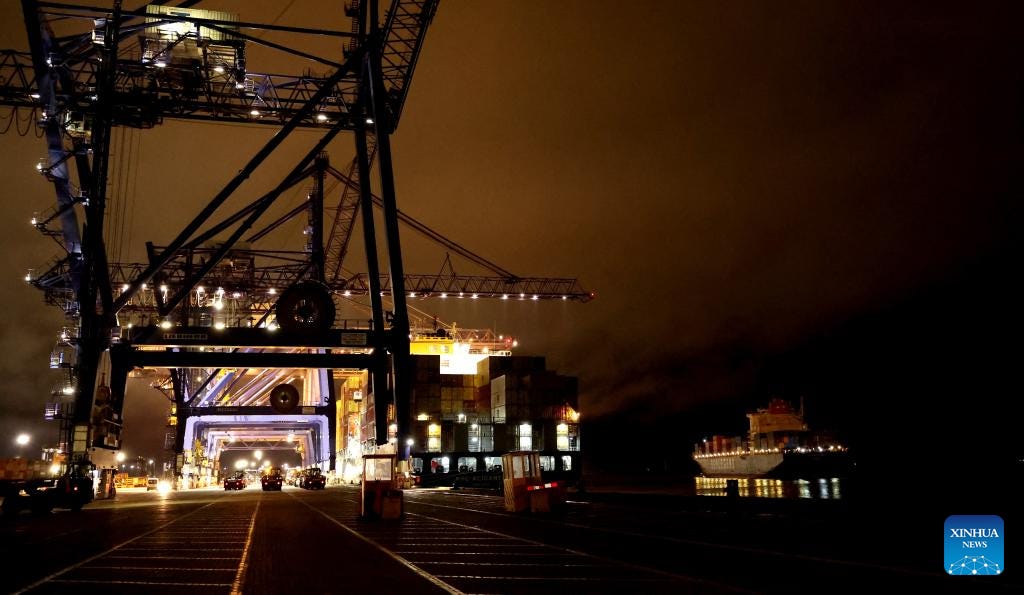
A Chinese container ship, the “Istanbul Bridge,” has just completed a voyage from a port on the east coast of China to Felixstowe in the UK, where it was welcomed with a huge banner display. The ship made the news because it avoided the usual sea route through the Suez Canal and instead sailed through Arctic waters using the coast-hugging Russian Northern Sea Route. The voyage is hailed as significant because of the much shorter sailing times it allows between China and Europe. The “Istanbul Bridge” made the voyage in just 20 days, including a delay caused by a storm off the coast of Norway. That’s half the time of the standard 40-day voyage via the Suez Canal; and the even longer, 50-day voyage around the Cape of Good Hope. [1]
China’s official news agency, Xinhua, has dubbed the voyage the opening of a new “China-Europe container express route.” [2] Cue official hyperbole. But the voyage does undoubtedly signal a Chinese effort to expand its maritime trade to Europe in the face of tariff wars with the US. In 2024, the EU imported more goods from China than any other single country; while China represented the EU’s third largest export destination. [3] If you want a graphic illustration of what might come to be a significant, longer-term trading pattern shift, exports from China to Europe rose by 14% in September, while shipments to the US fell by 27%. [4] Should the Northern Sea Route genuinely represent a new, major trade corridor between China and Europe, this will be a big deal. (Do I sound like Donald Trump?).
What did the containers on the “Istanbul Bridge” hold? Not tennis shoes and T-shirts. Instead, lithium-ion batteries and equipment for solar panels. Both goods like the cold temperatures and comparatively calmer seas of the coastal NSR.[5]
China has been exploring Arctic maritime commerce through the Northern Sea Route to European markets for over a decade, starting with the voyage of the 19,000 ton “Yong Shen” in August of 2013. [6] Chinese shipping through the Northern Sea Route ramped up in 2017, when a dozen vessels made the journey, up from five in 2016. Some of these voyages delivered equipment to oil fields and LNG plants along the route, and engaged in offshore drilling activities; others delivered wind farm equipment to Denmark. The Northern Sea Route was ever so slowly being absorbed into China’s vast belt and road initiative. [7]
But recent closer ties between China and Russia, prompted by Russia’s search for allies and partners after its invasion of Ukraine, and renewed trade tensions between China and the United States during Trump’s second term, have really altered the calculus of the benefits to China of the Northern Sea Route, despite the challenges it poses.
The Russian Northern Sea Route is not ice-free. At best, the ice-free shipping season lasts from July to November. Depending on conditions the window can narrow to two months. But what makes the NSR a viable Arctic shipping route is the combination of port infrastructure and a large ice-breaker fleet. There are six major seaports along the Northern Sea Route, compared to one, small port that could serve the Northwest passage (at Churchill, Manitoba). The Russian ice-breaker fleet numbers nearly fifty vessels in total, of various Polar classes, including 8 nuclear-powered heavy ice-breakers, the only vessels of their kind. The Russian fleet exceeds the existing Canadian and USA icebreaker fleets combined, though both countries are rushing to expand their capacity. [8]
Where does this leave Canada’s Arctic route through the Northwest passage? In truth, the Northwest Passage cannot compete with the Northern Sea Route as a future maritime trading corridor. Its development is decades behind. The Chinese have shown little interest in the Canadian route. The first Chinese icebreaker and research vessel, the Xue Long, originally built at a Ukrainian shipyard in 1993 and converted later in the decade for polar use, did make an unexpected appearance at the Western Arctic port of Tuktoyaktuk in 1999. It later made a circumpolar navigation in 2017 which included transit through the Northwest Passage. The voyage at the time was characterised as a Chinese probe of the Northwest passage to gauge its potential for maritime shipping, while Canadian security agencies cast suspicious eyes on the activities of the research vessel. [9] It carries a helicopter and an underwater drone.
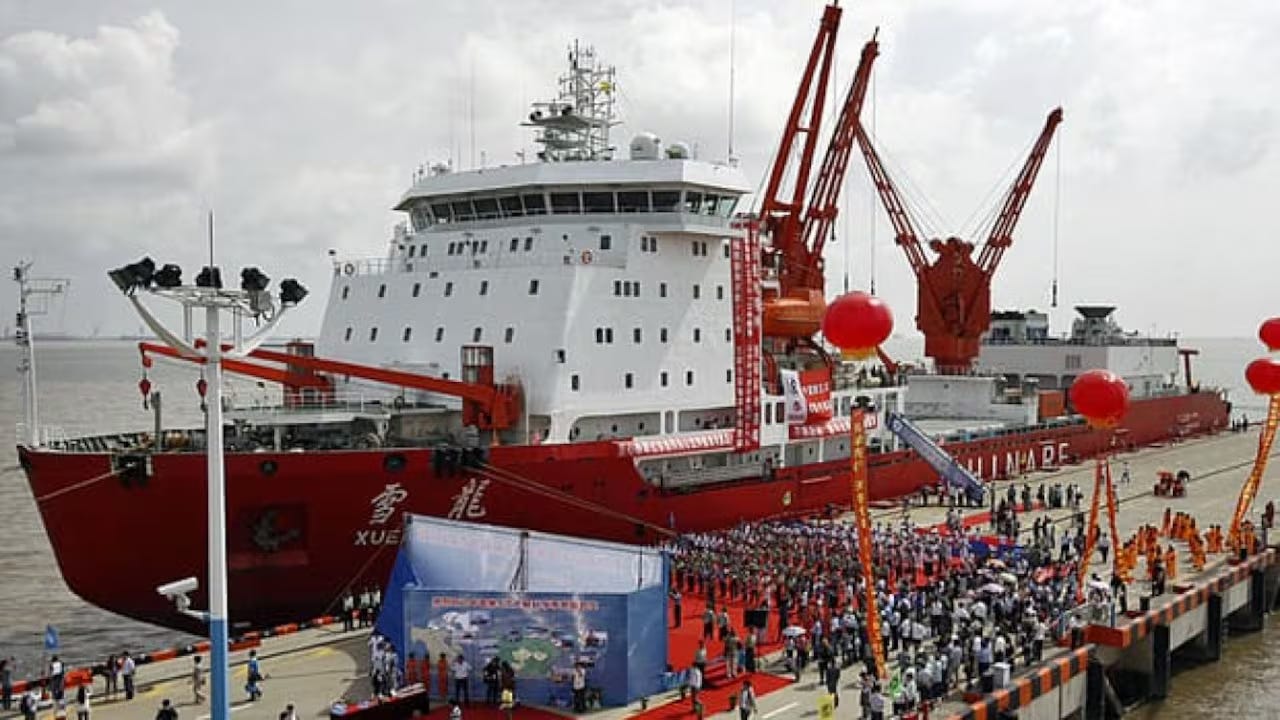
But despite adding a second polar class icebreaker to its fleet in 2019, the Xue Long 2, Chinese ice breakers/research vessels have not made a return visit to the Canadian Arctic.
Not a single Chinese cargo ship has ever transited the Northwest passage, despite the publication in 2016 of an official, detailed shipping guidebook, “Arctic Navigation Guide (Northwest Passage).” Even at the time, Chinese experts stated that “real commercial operations will have to wait a long time.” [10]
Even as Arctic ice melts and recedes due to the impact of climate change, predictive modelling as far out as the year 2100 shows it is unlikely that the Northwest Passage route through Canada’s Arctic will be globally competitive with the Russian Northern Sea Route. [11]
But that need not spell the end of a Canadian spirit of Arctic dreaming. It’s hard to imagine in the current geopolitical climate, but once upon a time Canadian and Russian officials were jointly enthusiastic for a project called the “Arctic bridge.” The concept involved building a trade route via the Northwest Passage that would link the port of Churchill, Manitoba, to the Russian Arctic port of Murmansk. It was raised as long ago as 1992 in talks between then Canadian PM Brian Mulroney and Russian President Boris Yeltsin. A pro-Western Russian ambassador to Canada, Georgiy Mamedov, became an enthusiastic proponent upon his arrival in Ottawa in 2004. The idea had the support of one-time Canadian foreign minister and Manitoba son, Lloyd Axworthy. [12]
What was the idea? At least in Russian minds it was to open up the North American market to Russian oil and LNG. For Canada? Open up the Russian north and beyond to our agricultural products.
It’s an idea from a distant planet in a universe far, far away. (Yes, the Star Trek crawler). Never to be resurrected.
But Arctic dreaming fails to die. [13] It has taken on a new shape prompted by the prospect of reaping a huge economic benefit from the exploitation of Canadian critical mineral wealth and getting it from the Canadian north and Arctic to global markets, especially in Europe. Churchill, Manitoba, again features as our only existing northern deep-water port, with access to the Northwest passage from Hudson Bay, and some infrastructure links to the south (a railroad and an airport). In addition to the imagined economic lure, development of a Canadian-controlled Arctic trade route could strengthen Canadian sovereignty in the region, especially if accompanied by a renewed military presence; enhance the livelihoods of Indigenous communities in the Arctic; and serve to deflect any US desire to encroach.
US pressure on Canada’s Arctic, especially in terms of resource exploitation and access to critical minerals must not be discounted. We’re not Greenland, but easily could be. When PM Carney and US President Donald Trump talked recently behind closed White House doors about “our shared efforts to bolster Arctic security…and the potential for further collaboration,” well, that sent a slight chill down my spine.
The Arctic chess board has changed. The Chinese are not coming; the Americans likely are. Its nyet to Russia. We don’t need nor want Russian oil and LNG, nor would we dream feverishly about exporting agricultural goods to sustain the Russian economy. But we will dream about critical minerals, including potash, uranium, copper, cobalt and nickel, and we must dream about restoring a real military presence in our fabled North. The dreamscape hovers over the sleepy, often ice-bound, polar bear haunted, port of Churchill. Its airport has one long runway. Does Canada’s Arctic dream?
[1] Arctic Today, (from Reuters), “Chinese freighter halves EU delivery time on maiden Arctic voyage to UK,” October 14, 2025, https://www.arctictoday.com/chinese-freighter-halves-eu-delivery-time-on-maiden-arctic-voyage-to-uk/
[2] Xinhua, “First ship on China-Europe Arctic route docks in Britain,” October 14, 2025, https://english.news.cn/europe/20251014/16ad3e26004c4d5b9f9d1331b178b85c/c.html#:~:text=Xinhua%2FLi%20Ying)-,%22Istanbul%20Bridge%2C%22%20the%20first%20vessel%20on%20the%20China%2D,of%20Felixstowe%20in%20east%20England.
[3] European Commission, “Eurostat,” February 2025, https://ec.europa.eu/eurostat/statistics-explained/index.php?title=China-EU_-_international_trade_in_goods_statistics
[4] Arctic Today, (from Reuters), “Chinese freighter halves EU delivery time on maiden Arctic voyage to UK,” October 14, 2025, https://www.arctictoday.com/chinese-freighter-halves-eu-delivery-time-on-maiden-arctic-voyage-to-uk/
[5] Xinhua, “First ship on China-Europe Arctic route docks in Britain,” October 14, 2025, https://english.news.cn/europe/20251014/16ad3e26004c4d5b9f9d1331b178b85c/c.html#:~:text=Xinhua%2FLi%20Ying)-,%22Istanbul%20Bridge%2C%22%20the%20first%20vessel%20on%20the%20China%2D,of%20Felixstowe%20in%20east%20England
[6] Robin McKie, The Observer, “China’s voyage of discovery to cross the less frozen north,” August 18, 2013, https://www.theguardian.com/world/2013/aug/18/china-northeastern-sea-route-trial-voyage
[7] High North News, “China sends more than a Dozen Vessels through the Arctic Ocean,” Dec. 6, 2017, https://www.highnorthnews.com/en/china-sends-more-dozen-vessels-through-arctic-ocean
[8] Gzero media, “Graphic Truth: Russia’s icebreaker fleet dwarfs US and Canada,” November 2, 2023, https://www.gzeromedia.com/gzero-north/graphic-truth-russia-s-icebreaker-fleet-dwarfs-us-canada
[9] Canadian Global Affairs Institute, reprinted from Robert Fife and Steven Chase, The Globe and Mail, “China used research mission to test trade route through Canada’s Northwest Passage,” September 10, 2017, https://www.cgai.ca/inthemediaseptember102017; BCB, “The Current,” story transcript, “Critics fear China’s foray into Northwest Passage endangers Arctic Sovereignty,” September 15, 2017, https://www.cbc.ca/radio/thecurrent/the-current-for-september-15-2017-1.4289717/critics-fear-china-s-foray-into-northwest-passage-endangers-arctic-sovereignty-1.4291840
[10] Nathan Vanderklippe, The Globe and Mail, “China reveals plans to ship cargo across Canada’s Northwest Passage,” April 20, 2016, https://www.theglobeandmail.com/news/world/china-reveals-plans-to-ship-cargo-across-canadas-northwest-passage/article29691054/
[11] Nature, “Ships are projected to navigate whole year round along the North Sea Route by 2100,” https://www.nature.com/articles/s43247-024-01557-7
[12] Isabel Teotonio, “Why we need an Arctic Bridge,” May 10, 2004, https://www.iatp.org/news/why-we-need-an-arctic-bridge
[13] See Wesley Wark, “So you want an Arctic trade corridor,” October 9, 2025, https://wesleywark.substack.com/p/so-you-want-an-arctic-trade-corridor
Interesting piece. 👍🏻
First thing first :)
In terms of reliability - China wins over the U.S. again :)
When Russia sent the 19 drones into Poland not so long ago, Poland instantly closed the border with Belarus.
That's where Chinese shipping route got stuck.
I have no idea if those were trucks or trains. The Chinese delegation arrived to Poland to negotiate opening the border to at least let cargo that's stuck in Belarus at that moment. I didn't follow up on that, so I don't know, if anything was resolved or not.
All I know Chinese shipment to EU got stuck in Belarus.
And they now made their first successful trip to Europe through Arctic?
It's pretty impressive, if you ask me.
If only Canada disconnected itself from the U.S. fear mongering paranoia pressed upon us and pounded into our heads by the U.S. that anything China - bad, anything U.S.A - bestest in the world good...
Now, who's the most reliable business partner?
Our 'friends' who want to annex is, impose tariffs on us any way they want, send their goons 'diplomats' to constantly insult us into submission to do what they want and give them what they want, because they have been subsidizing us?
What I see is that Canada seems to be infected with a parasite I just can't make up my mind yet if it's our conservative party or our bestest "friends' in the White House?
But considering the fact that Conservatives are so into our faces Un-Canadian and just from the way they constantly kue and seem to sabotage any progress in anything that could benefit Canada, it just hurts.
Does it look like China wants to conquer Europe?
I don't think so.
And the White House lost any moral ground to actually criticize anyone.
I have a feeling that idea of a golden dome over our Arctic for which Trump wants Canada to pay heavy billions, has more to do with controlling the passage of cargo shipments through
Arctic - and the idea that Trump, I mean - the U.S. is not going to make a dime on it? Ouch.
We should learn from the best, not get stuck with the worst.
But darn, it's impressive - one of their shipments to EU got stuck because of Russian drones, so they already made it through the Arctic?
And no, I don't think Carney should ditch an investment into building the port in Churchill and the fact that Wab Kinew was he first with the proposal, but got ditched like a sack of potatoes from the first announcement of projects lined up for approval by Carney?
Ok. I won't start that rant now :)
But despite China's new Arctic passage and all, I think it is much more beneficial for Canada and Canadians to invest in Manitoba's infrastructure that it's lacking now, and invest in that port, than revive the Keystone XL pipeline that goes straight to the US and be at the mercy of a current dictatorship and the future whatever the U S. turns into.
Two presidents shut it down already, and there is no guarantee that the future leaders won't do the same.
Besides, Alberta wants to become the 51st state anyway, so building them a pipeline as a farewell gift on Canadian taxpayers dime ? :)
Cheers.