Australia and Canada: Different security neighbourhoods, same boat?
Or, what to do in the insecure age of Trump



Australia and Canada. Strategic cousins. Westminster-style parliamentary democracies, Commonwealth countries, intelligence partners in the Five Eyes, similar size militaries. Australia describes itself as an “influential middle power.” [1] That aspirational label would apply to Canada as well, especially in light of the PM’s Davos speech in January. [2]
Both countries have embarked on major and rapid enhancements to their military capabilities in the face of a dangerous and uncertain geopolitical environment. Both countries share a history of close security ties with the United States and de-facto dependency. Australia and Canada both rely on US military force for protection in the event of major conflict, and for deterrence to prevent its outbreak. Both countries, non-nuclear weapons states themselves, are wholly dependent on the US nuclear deterrent.
Australia and Canada face a similar challenge—how to adapt to the emergence of an unreliable, but still in some ways necessary, security partner in the United States.
This makes the publication by the Australian government of its latest National Defence Strategy (April 2026) of intrinsic interest to Canada, not least as our own defence strategy, issued in 2024, pre-Trump, now looks outmoded and an update is not promised until 2028.[3]
Australia and Canada live in different neighbourhoods, to be sure. But both have lost a sense of geographic invulnerability. Australia, an island continent in the southern hemisphere, can no longer claim invulnerability from its ocean surround or its distance from potential sources of conflict. As the defence strategy makes clear, geographic isolation can no longer protect Australia from long-range missiles, space and cyber threats, disinformation, supply chain disruptions or the general erosion of global rules and norms. [4]
All true for Canada, as well. Canada is pivoting to a sense of long-term strategic vulnerability facing a climate change-transformed Arctic Ocean and its points of access. Canada lives uncomfortably close to a US that is embracing authoritarian politics, determined to exert a 21st century doctrine of great power politics, and signalling its predominance over the entire Western hemisphere. Australia’s greater distance from the US may not matter in the context of its security dependency.
What can a dive into the Australian national defence strategy offer?
We can start with the cover picture. It features, in the foreground a drone, called the “Ghost Bat.” It’s designed and built in Australia. In the background is an F-35 fighter jet, an American product.
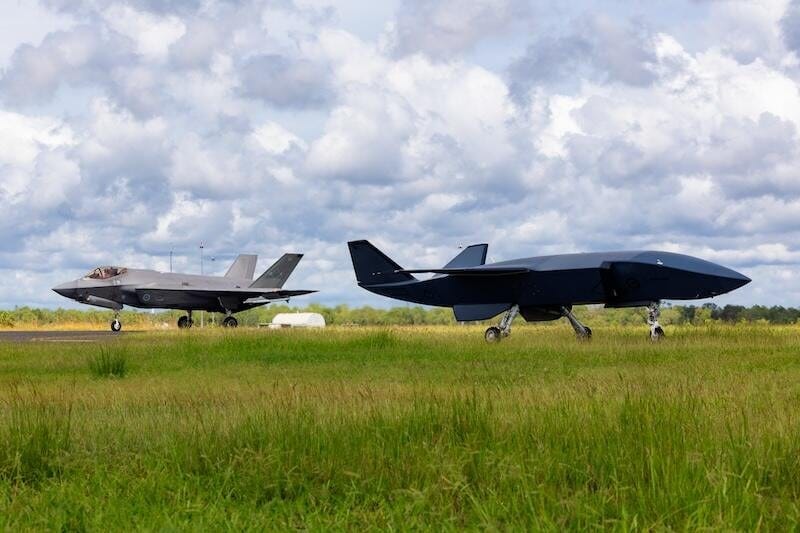
In many ways the cover illustration identifies key themes in the Australian report: the need to modernise defence capabilities, acquire new weapons systems, spend more and build up a stronger defence industrial base, achieve greater self-reliance, alongside a determination to maintain an alliance relationship with the US. There is an inherent tension there that is not all that different from the one confronting Canada.
Australia’s reliance on the US as its key defence partner, indispensable for security in the Indo-Pacific, is referenced in many parts of the strategy. Perhaps the clearest example is this statement:
“Australia-US security arrangements, interoperability, intelligence sharing and industrial collaboration remains critical to Australia’s national security.” [5]
There is an unquestioned belief that Australia and the US continue to “share strategic interests” and have a “mutual respect for each other’s sovereignty and national interests.” [6] Alongside those assumptions, the defence strategy asserts the need to strengthen defence engagement with the US even further.
The Australian strategy does acknowledge the value of other security partnerships in the Indo-Pacific region, including with Japan, the Philippines, Singapore, Indonesia, and, a little more tentatively, South Korea. But there is no dynamic at play here that suggests Australia sees any of these partnerships as anything other than secondary for Australian security.
Instead, it seems that key capabilities acquisitions are driving Australia further into the embrace of the US security partnership, above all the long-term plan for a fleet of nuclear powered and conventionally armed submarines, through the AUKUS arrangement, and a new precision strike missile program entirely dependent on US support.
Australia is a middle power whose security neighbourhood is the Indo-Pacific. While it recognizes that operating as a middle power requires stronger military capabilities, it has no intention of searching for new middle power coalitions or re-thinking its military bonds with the US. Instead, its defence strategy is designed to increase its ally-worthiness for the United States. In that sense Australia is moving forward with greater military power by moving back, all on the assumption that nothing fundamental has changed in the nature of the exercise of American power, politics, or in relations between the two countries.
Given that Australia and Canada are in the same military modernization and growth race, there is still value in paying close attention to defence developments ‘down under.’ But where the two countries diverge is in their approach to geopolitics and especially to security dependency on the United States. Where Australia seeks to deepen that dependency, Canada seeks fundamentally to lessen it.
Canada can look to new security and defence coalitions with the Nordics, NATO partners, and the EU, as we lean towards Europe and away from the United States. Australia clearly feels it doesn’t have the luxury of any decoupling from the United States.
That may be realism, Australian-style, but it needs to be accompanied by a clearer-eyed view of the US and more ambition to be a truly “influential” (and independent) middle power.
[1] Australia, National Defence Strategy 2026, p. 19, https://www.defence.gov.au/about/strategic-planning/2026-national-defence-strategy-2026-integrated-investment-program
[2] PMO, Transcript of speech at the World Economic Forum, Davos, Switzerland, January 20, 2026, https://www.pm.gc.ca/en/news/speeches/2026/01/20/principled-and-pragmatic-canadas-path-prime-minister-carney-addresses
[3] Canada, Department of National Defence, “Our North, Strong and Free,” May 2024, https://www.canada.ca/en/department-national-defence/corporate/reports-publications/north-strong-free-2024/executive-summary.html
[4] Australia, National Defence Strategy 2026, p. 15, https://www.defence.gov.au/about/strategic-planning/2026-national-defence-strategy-2026-integrated-investment-program
[5] Ibid, p. 13
[6] Ibid, p. 59
[Or, what to do in the insecure age of Trump]
I can't help but comment on something just up in the press last day or so on the Airbus Canada Limited Partnership A220 contract with AirAsia https://www.theglobeandmail.com/business/article-airbus-wins-order-for-as-many-as-150-canadian-made-a220-planes-from/
Can the Gripen announcement be far behind? Even though Airbus partner in the Eurofighter Project (a competitor to Saab) there's a move within Europe to consolidate on further projects. Bombardier's 'creed' just grew.
Someone should tell donald to duck...
Interesting. Irvin Studin commented a few years ago that Australia has greater awareness of its vulnerability, going back to World War II, and thus takes its national security quite seriously. With Trump 2.0 threatening to annex Canada, we're now in a similar geographic situation to Australia: a long way from friendly countries.
"My humble observation is that while Australia is a smaller, younger and considerably less complex federation and society than Canada, its security and intelligence community and culture are not only better resourced than Canada’s but also far more serious in terms of their 'felt appreciation' of the consequences of failure.
"How could this be so? Answer: The Australians had a reckoning with strategic (indeed, existential) bad luck that Canada had not experienced until the coronavirus emergency. Australia saw itself as abandoned during the Second World War to Japanese bombardment by its principal imperial ally, Great Britain. Thenceforth, Australia would have to defend itself."
https://policyoptions.irpp.org/2020/05/five-post-pandemic-pivots-in-canadian-security-and-intelligence/