Flying the Maple Leaf in the Strait of Hormuz?
Or, ready aye ready?

-
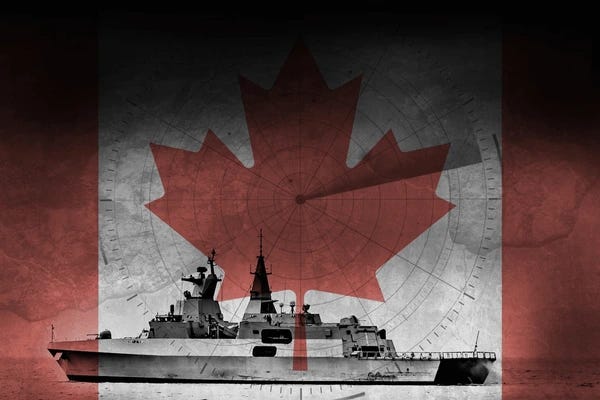
Let’s look ahead.
One of the key points in the framework peace deal being discussed between the U.S. and Iran is that the Strait of Hormuz be re-opened (see my previous substack, “The Fog of Peace”). Currently it is being blocked by both belligerents. Both sides want maritime commerce to resume through this vital waterway, though on very different terms. If agreement can somehow be reached the Strait is meant to be re-opened quickly—within 30 days.
Re-opening would require some kind of international monitoring force, not least to reassure the commercial insurers of the tankers and bulk carriers that move through the Strait. This is where the UK-French-led Multilateral Maritime Mission (MMM) comes into play. The MMM is still in the planning stage, but its intent would be to provide a naval force to police a reopened Strait of Hormuz, in the event that a peace deal holds and the Strait is deemed safe (enough) for renewed maritime commerce.
Those conditions, of course, have not yet arrived, but you cannot stand up a multilateral naval force overnight. Hence the planning, which would include issues of force composition, command and control, international law standing, regulations on any interception or inspection of ships, logistics and ports of call.
The MMM if it ever goes into action—and that remains a big if—would require a naval force with significant intelligence capabilities to monitor threats, strong anti-drone and anti-missile defences, a capability to detect and destroy small fast boats of the kind the IRGC deploys, and minesweeping capacity.
Canada will soon find itself under pressure from London and Paris to make commitments to join the Multilateral Maritime Mission.
There will undoubtedly be political interest in making a distinctive Canadian commitment to the MMM. It would serve to reinforce the government’s orientation to a closer security partnership with key European allies, demonstrate resolve with the Gulf states, seen as important economic and investment partners for Canada, and provide a way of pushing back against the Trump administration’s ongoing denigration of NATO.
But do we have hard power platforms that could be useful?
On minesweeping, the answer is no. The current fleet of Canadian minesweepers, the Kingston-class Coastal defence vessels, are minor warships, with non-existent modern air defence systems. Of the 12 ships in the class, 8 have been de-commissioned and the remaining four are scheduled to be phased out by 2028. [1] Their functions have been temporarily taken over, while a new ship class is being considered, by the Navy’s fleet of six Arctic and Offshore Patrol vessels. But these ships are meant primarily for surveillance operations and sovereignty patrols, not as combatants.[2] They would be defenceless in any situation where they might face missile and drone attacks, and they do not have minesweeping gear.
No, we don’t have an aircraft carrier, unlike the British or French navies. The last Canadian aircraft carrier, the HMCS Bonaventure, was decommissioned in 1970 as a cost-cutting exercise and sold for scrap. [3]
That leaves the current fleet of Halifax-class frigates, of which the RCN has 12, based on the East coast at Halifax and on the West coast at Esquimalt. The frigates do not serve as mine sweepers. They do come equipped with an array of air-defence weaponry, including Sea Sparrow missiles for medium range defence, a Bofors 57 mm cannon (dual-use) and a rapid fire 20mm Phalanx machine gun, for close-in, last-ditch defence. They also carry updated surveillance radars for detection of airborne threats. [4]
What the frigates don’t currently have are dedicated counter-drone (or counter UAS) systems. The RCN is acquiring a set of six of these to equip the frigates, but they won’t start to arrive until 2028 and won’t be fully operational until 2032. [5] They are being built under contract by MDA space. [6] This timeline seems to reflect older procurement processes and a lack of urgency. Hopefully, someone at DND is looking to speed it all up.
So, were a decision taken to make a commitment to the MMM, the only available platform Canada has would be a Halifax-class frigate. But these ships would also be vulnerable to drone attack, particularly from drone swarms, and would have to rely on borrowed air defence support from other naval elements of the Mission. That would add a complication to the commitment, but would not be insurmountable.
If the government does decide to join the Maritime Monitoring Mission, this would not be a simple fly the flag operation. The hope has to be that any Canadian commitment is made with eyes wide open to the risks, not just about the complexity of the mission but the vulnerability of any RCN vessel deployed.
[1] Kingston-class Maritime Coastal Defence vessels, https://www.canada.ca/en/navy/corporate/fleet-units/surface/kingston-class.html
[2] Naval Technology, Harry deWolf Class Arctic and Offshore Patrol Ships (AOPS), https://www.naval-technology.com/projects/harry-dewolf-class-arcticoffshore-patrol-ships-aops/?cf-view
[3] HMCS Bonaventure, https://www.canada.ca/en/navy/services/history/ships-histories/bonaventure.html
[4] Halifax-class frigates, https://www.canada.ca/en/navy/corporate/fleet-units/surface/halifax-class.html
[5] Department of National Defence, “Royal Canadian Navy to enhance maritime operations with new uncrewed aircraft systems,” August 5, 2025, https://www.canada.ca/en/department-national-defence/news/2025/08/royal-canadian-navy-to-enhance-maritime-operations-with-new-uncrewed-aircraft-systems.html; The Watch, “Royal Canadian Navy upgrading frigates with UAS systems, “ September 10, 2025, https://thewatch-journal.com/2025/09/10/royal-canadian-navy-upgrading-frigates-with-uas-systems/
[6] MDA Space Media Release, August 5, 2025, https://mda.space/article/mda-space-awarded-contracts-for-royal-canadian-navy-uncrewed-aircraft-systems-maritime-operations
sorry all for the troll that keeps turning up on this site under ever-changing aliases. Thanks for all the legitimate comments and to Richard Gimblett for pointing out his new book
A very good article, Mr. Wark. The dilemma of inadequate air defence capabilities for the Halifax class, the preponderance of drone attacks and the consequences of a US/Israeli incursion without notification to allies has placed the RCN in an awkward position.