Intelligence oversight no more
Or, artless dodging

The United States was the world’s pioneer is establishing mechanisms for oversight and review of its powerful and secretive intelligence community. In the mid-1970s, spurred by the crimes of the Watergate era and revelations about disturbing US intelligence activities at home (illegal domestic spying) and abroad (covert operations aimed at regime change, and assassination plots), Congress established two committees, one in the House and one in the Senate, respectively the House Permanent Select Committee on Intelligence (HPSCI) and the Senate Select Committee on Intelligence (SSCI). Note “select” in the title. These committees, the first of their kind in any democracy, were meant to be powerful bodies, with specially chosen memberships, able to have access to classified material. They were designed to keep a watch on intelligence agencies, to expose abuses, and highlight capabilities gaps.
Fifty years later the original design has been exploded by the political polarities and extreme politics of the Trump era.
The greatest problem now facing the US intelligence community is not its covert practices, its abuses, or its capability gaps. The greatest problem is its politicisation—being turned into a pliant tool of an administration, unable to generate unbiased and relevant intelligence for decision-makers, simply another instrument of an imperial presidency.
That problem meets intelligence committees wholly unable to deal with it, because they have become echo chambers for partisan political warfare. Administration officials believe they have full leeway to stonewall and ignore any efforts to force a confrontation with unpleasant truths.
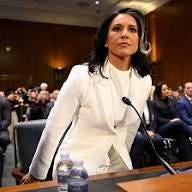
This dynamic was on full display in a televised Senate intelligence committee hearing on March 17 to address the work of the Director of National Intelligence (DNI) and the annual report to Congress on an assessment of world-wide threats. It’s a rare occasion to hear in public from intelligence community leaders. [1]
For this hearing, the Trump administration took the stand with three political appointees and two professional intelligence heads. The three political appointees were Tulsi Gabbard, the Director of National Intelligence, Kash Patel, the director of the FBI, and John Ratcliffe, the Director of the CIA. The two professional intelligence chiefs were the head of the Defence Intelligence Agency, the Pentagon’s intelligence arm, General Adams, and the Director of the National Security Agency, responsible for signals intelligence and cyber effects, General Hartman.
Much ink has been spilled about the utter lack of qualifications of many of Trump’s appointees, with Gabbard and Patel being especially egregious examples. Utter lack beyond political loyalty, that is. It’s too dispiriting to spill more, so I won’t.
Gabbard, as the senior administration official in charge of intelligence, at least in theory, took some of the hottest heat of Congressional questioning from Democrats on the committee. She gave an opening presentation and droned on for 20 minutes. Then the fireworks began. Democrats attacked her, especially on the intelligence community’s understanding of the Iran threat and what they told the President. She stayed on message, which was essentially to deliver no message about how the intelligence community addressed the Iran question. But Gabbard also indicated that it was her belief that whatever the intelligence community knew about Iran, and any imminent threat it might have posed, it didn’t really matter because, as she said:
“the only person who can determine what is and is not an imminent threat is the President.”
Gabbard added another gob smacker, in the face of some relentless questioning from the youngest senator on the Committee, Democrat John Ossoff. In refusing to address inconsistencies in her own statements about whether or not Iran posed a nuclear threat to the US, Gabbard stated:
“it is not the intelligence community’s responsibility to determine what is or is not an imminent threat.”
These are staggering notions that completely undermine the very purpose of an intelligence system, at least one in a democratic state.
It would, of course, be entirely commonplace in a totalitarian, fascist or Putinesque regime. The inability of intelligence agencies to function independent of political direction and deliver their best judgements on threats is precisely one of the reasons why totalitarian and fascist regimes often stumble or fail miserably in their foreign and military policies. History is littered with examples--from Stalin’s unwillingness to believe that Hitler might attack him in 1941, to Nikita Krushchev’s belief that he could get away with putting nuclear warheads and missiles into Cuba in 1962, to Saddam Hussein’s firm conviction that the US would not go after his regime in 2003, to Putin’s belief that nothing could stop his blitzkrieg against Ukraine in February 2022. And now we have Trump. Only he can determine.
It’s true that the intelligence buck stops at the President’s desk. Intelligence doesn’t dictate policy, but it is meant to inform wise-decision-making. This is where Gabbard’s language about ‘determine’ is so dangerous. It obfuscates the role of intelligence and leaves the suggestion that Trump is his own intelligence chief—a very damaging confession.
The CIA Director, John Ratcliffe, nominally subordinate to Gabbard as DNI, is a smoother operator than his boss. One can see why he has closer ties and more exposure to the President. He is also a more capable fabulator than Gabbard.
Ratcliffe held to the Trump administration’s line that Iran “posed an immediate threat at this time” and claimed that the CIA was aware that Iran “had specific plans to hit US interests and energy sites across the region.” What he didn’t clarify was whether those plans were in response to an Israeli and US attack. This was all part and parcel of Ratcliffe’s own ducking and weaving before the committee on how the intelligence community had assessed likely responses by Iran to an attack, including the closure of the Strait of Hormuz.
Watching this two- hour and 23-minute long political gong show left me thinking about the comparative benefits of the Canadian review system, particularly as exemplified by the National Security and Intelligence Committee of Parliamentarians (NSICOP). Canada was a very late comer to legislative branch review of intelligence, but the system we finally put in place, starting in 2017, has attributes that vault it above the current American one.
NSICOP isn’t in the public eye and gets little attention and few headlines from the media. It doesn’t hold any public or televised meetings. Instead, it gathers in a SCIF for classified briefings and discussions. While its membership consists of representatives from both the House of Commons and Senate and from all official political parties, it operates in a dedicated non-partisan fashion, has no majority in control, takes no votes, does no grandstanding, and produces consensus reports, no dissenting footnotes, thank you.
Many of its reports, going back to its first annual product for 2018, have been extremely valuable for public education, political debate, and as prods to improved performance by intelligence and security agencies. Want to know how the government determines intelligence priorities, what the status of diversity and inclusion is in the ranks of the intelligence community, what Global Affairs does in the intelligence field, how our cyber defences work, what the challenges of lawful access might be, read the NSICOP reports, all unique contributions.
I would hold out hope that were the Canadian intelligence system ever to be beset by the kind of woeful politicisation on display in the US, that NSICOP would call it out.
No review circuses here.
[1] Happy viewing: https://www.intelligence.senate.gov/2026/03/17/open-hearing-worldwide-threats-2/
I started selecting quotes from Wark's accurate diatribe, and I'll perhaps post them and comment on them individually later, but Wark reaches an overview that I too have reached lately.
Suffice to say in a nutshell: "The US model has reached its point of incompetence".
The comparison to NSICOP is just one example where another model, at least at this point in time, is proving superior to the US one. The failing of the US model is more than that. It's endemic and pervasive.
I didn't think I'd ever state this, but a monarchy or a pseudo monarchy appears to have a distinct advantage. That's not to say that I'm a monarchist, UK's Monarchy (and by adoption, ours) is badly fractured, but I couldn't help but admire the Swedish one when they came to Canada a few months back to promote Saab.
To be continued...
I was embarrassed watching these political hacks prevaricate and bluster in response to seemingly concise and logical questions. I can only hope the two men in flashy medals and military garb felt the same. Not that it matters ... they must bend the knee to the "Commander in Chief," or be thrown under the war machine bus.
Thanks for explaining with great clarity the Canadian system in comparison to the 3 ring circus the USA uses. We are fortunate to have avoided such committee chaos, at least so far.