Mark the Builder
Or, big projects in the North and Arctic


The Prime Minister is off on another international trip, one that began with a stop-over in Yellowknife to make a set of announcements about defence spending for northern and Arctic security and new infrastructure projects.
The defence spending announcements were not exactly new. Sure, we learned more details of the spend, but the interesting part was the language now being adopted by the Carney government to support efforts in the north and Arctic, after so many previous tries by predecessor governments.
In announcing a big tranche of money, nearly $35 billion in total, for military basing infrastructure in the Arctic, the PM described this investment in two ways. Mark Carney suggested it demonstrated that his government had a bigger vision for Arctic security and sovereignty than any of its predecessors. More importantly, he stated that Canada would now take full responsibility for the defence of the Canadian Arctic, without, he announced “the help of allies.” [i] Whoa. This suggests that the Carney government is looking to a long-term future in which the essential underpinning of Arctic, and indeed North American, defence, for decades provided by the NORAD alliance with the United States, would be superseded by a much more independent Canadian military capability. The death of NORAD was not being announced, but its diminishment as the strategic framework for Canada and the beginning of the end of Canadian defence over-dependence on the US, was.
The spending announcement on new airbase infrastructure in the Arctic (at Yellowknife, Inuvik and Iqaluit) is designed to ensure that the next generation of Canadian fighter jets (decision still pending on whether the fleet will comprise F-35s or Saab Gripen-Es, or some combination of the two) would be able to operate in a more sustained way out of bases in the region. Without such Arctic infrastructure, RCAF jets have to take long flight paths from their southern bases at Cold Lake and Bagotville and require air-to-air refueling for any sustained air patrols in the vast Arctic region. The new airbase infrastructure will also allow for the future deployment of long-range drones, early warning aircraft (yet to be acquired) and long-range patrol planes.
Operational support hubs (at Whitehorse and Resolute) and nodes (Cambridge Bay and Rankin Inlet), as the military are calling them, will allow for pre-positioning of supplies and gear to help the Canadian army conduct exercises and operate in a more sustained way in the region, despite the formidable conditions imposed by the Arctic environment. Pre-positioning is vital given the difficulties of getting military supplies into the region, especially given the lack of transportation infrastructure and a short shipping season through the Northwest passage. [ii]
This was the military side of Mark the builder.
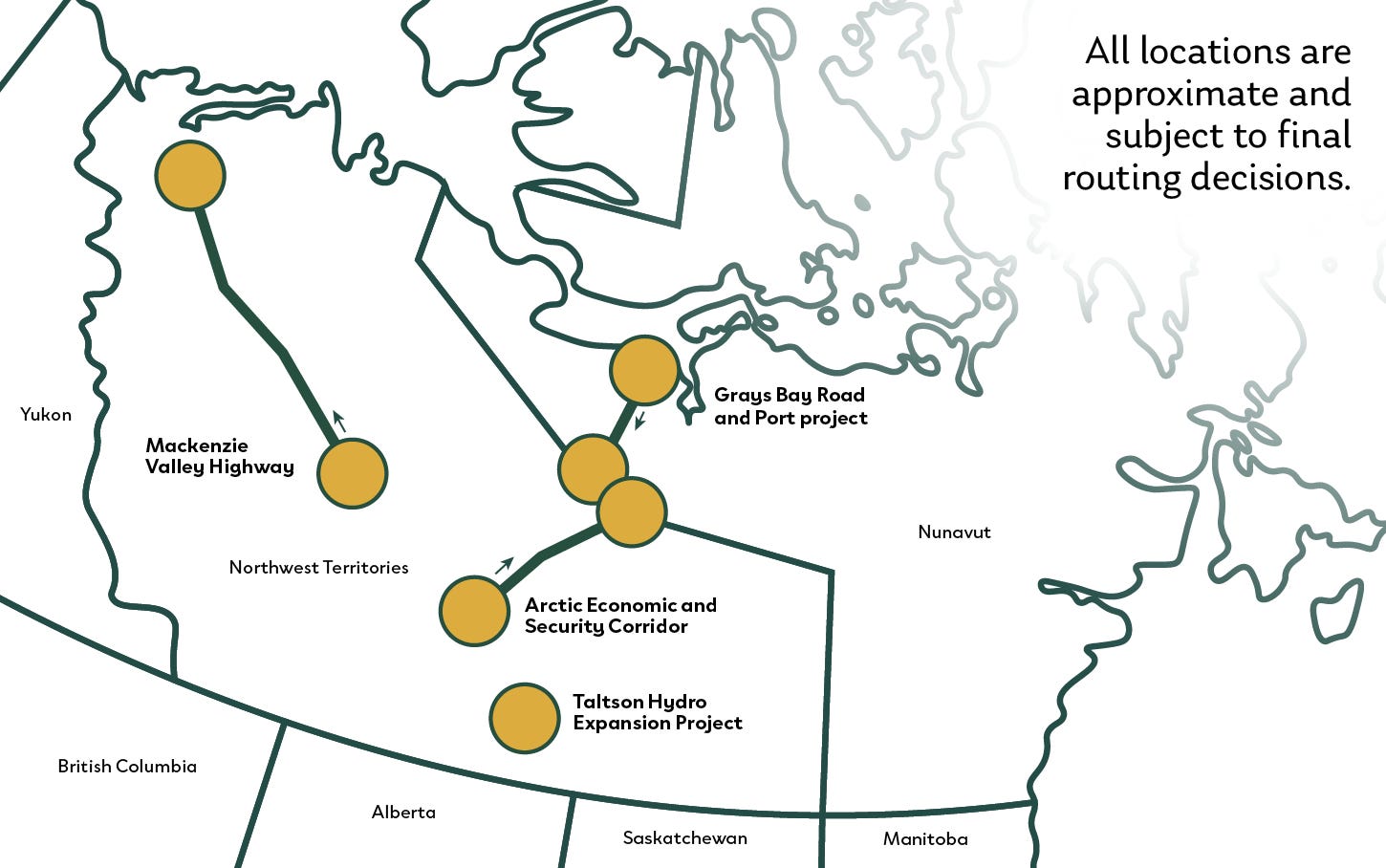
The Prime Minister also made an announcement in Yellowknife about a number of major economic projects, “Northern Resilience Projects,” to transform the Canadian North and Arctic. [iii] They are at the design stage only; all are extremely ambitious (and costly). The enterprises are being referred to the Major Projects Office for consideration for federal government support and implementation. They constitute traditional infrastructure enterprises launched in a very challenging and non-traditional Arctic environment, where permafrost melt and weather extremes pose major problems for the maintenance of transportation networks and power grids. Among the projects, we have a proposal for an all-weather road linking Yellowknife to the western Arctic at Inuvik (the Mackenzie Valley Highway), a 400 km all-season road linking the Great Slave Lake region (“Slave Geological Province”) to the Nunavut border in the eastern Arctic, and a hydro project in the Northwest territories (Taltson Hydro Expansion Project) to build out a clean energy grid in the region. All of these projects are designed to increase the economic capacity of the region, especially in mineral extraction, and to connect previously isolated communities. But the most visionary and ambitious of them is something called the “Grays Bay Road and Port Project,” which involves building yet another all-season road, this time from the Nunavut border to a deepwater port and airfield at Grays Bay in the central Arctic. There is currently no road, no port and no airfield. The road and airfield only make sense if the port can be built; the port only makes sense if Canada has the heavy-ice breaker capability that would be needed to keep goods flowing out of the port for an extended season. Our aged ice-breaker fleet is being reconstituted, but only at current levels (two heavy-ice-breakers, called “Polar” ice-breakers, are under construction). They won’t be available until the early 2030s. More will be needed. That would be an important “dual-use” project for the Arctic economy, security and sovereignty.
What these announcements signal is that the Carney government has identified the links between economic and national security in the Canadian North and Arctic. Now we need to build those links.
How Canada will position its announced, independent Arctic security posture, between NORAD and NATO alliance commitments, is another project for the future.
More on that to come…
[i] PMO, “Prime Minister Carney announces ambitious new plan to defend, build and transform the North,” March 12, 2026, https://www.pm.gc.ca/en/news/news-releases/2026/03/12/prime-minister-carney-announces-ambitious-new-plan-defend-build-and
[ii] Ibid
[iii] PMO, Backgrounder, https://www.pm.gc.ca/en/news/backgrounders/2026/03/12/prime-minister-carney-announces-ambitious-new-plan-defend-build-and
All commenters have raised excellent points: from a diversification from Canada/US continental defence to a broader Arctic defence predicated on northern Nordic nations/NATO context. For years our country has been delinquent on believing our Arctic was just that appendage…
Canada now smartly and belatedly realizes that our Arctic is the northwestern flank of NATO. This change is crucial as NATO cannot be guaranteed continued active participation of the US. Our Arctic is our place first and requires our demonstration of sovereignty.
The crucial elements of protecting environmental, animal migration routes and above all the active participatory engagement of Indigenous peoples is vital.
I believe MP Idlouts’s move to the Liberal government is wise. She has seen a plan of action. Canadian prime ministers and politicians for decades talked the big nonsense talk about the Arctic. Now someone is actively moving forward with actions and attitudes to match previous unachieved aspirations. The stalled port of Nanisivik was a primary example of poorly articulated Arctic planning.
We can do much better!
Excellent amble.
[This suggests that the Carney government is looking to a long-term future in which the essential underpinning of Arctic, and indeed North American, defence, for decades provided by the NORAD alliance with the United States, would be superseded by a much more independent Canadian military capability.]
When I first heard that, I had to consult the written press to be sure I had heard it correctly. What's curious is how little the weight of that has been reported in the wider press.
Edit to Add: On further thoughts, this segues to the acquisition of the Gripen.