Valentines exchanged at Munich
Or, Europe has to read the fine print on the transatlantic relationship

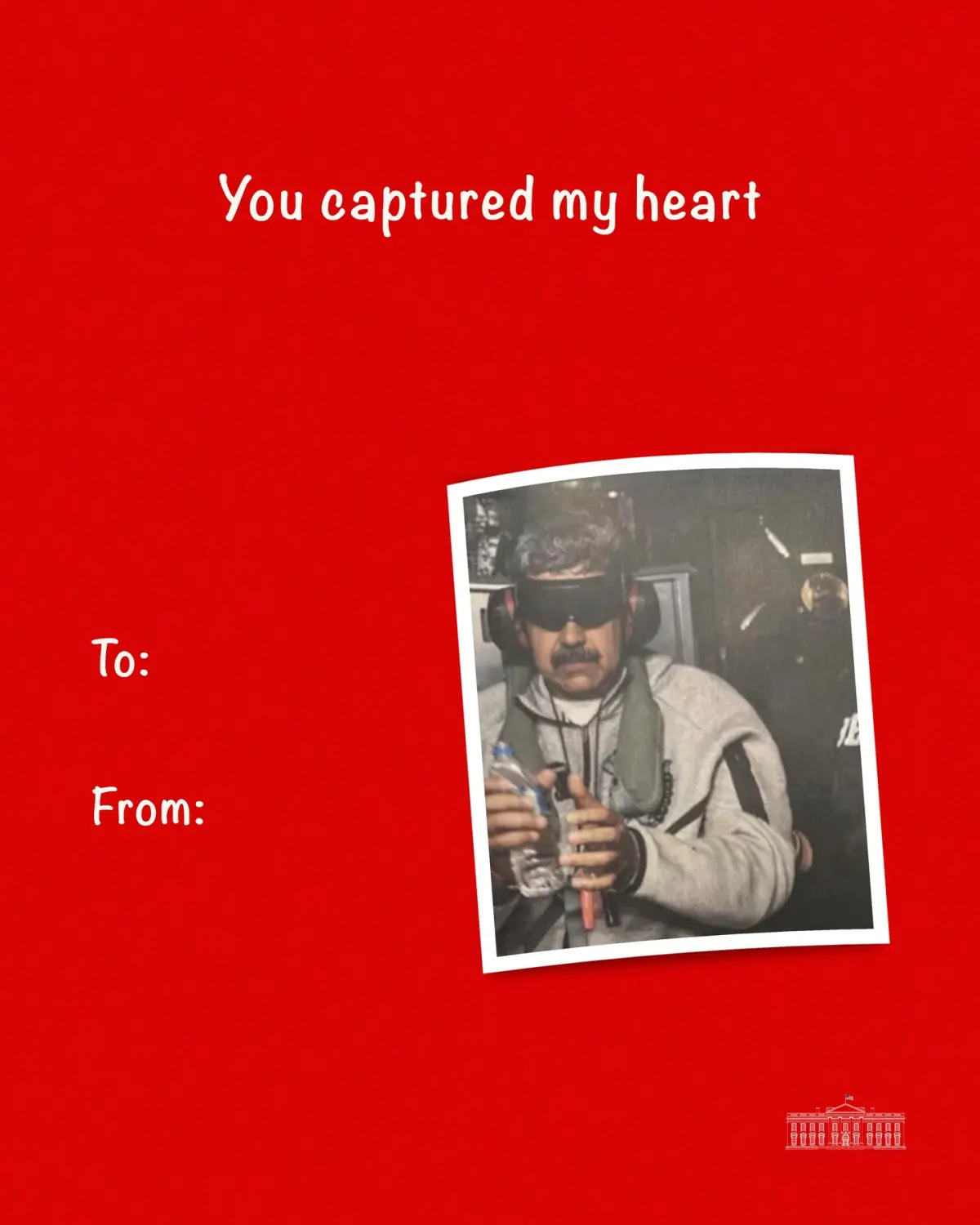
(Honest to god, this is a White House post card)
The first day of the Munich Security conference was book-ended by speeches from two key European leaders. German Chancellor Friedrich Merz led off; France’s President Emmanuel Macron brought the day to a close. Merz spoke in German; Macron in English. [1]
They had subtly different things to say about their view of a new Europe in the world, and about the transatlantic relationship. Neither went after the United States as the world’s wrecking ball, but both leaders had doubts about Trump administration policies. Neither was as strident as the independently-written Munich Security Conference report had been, perhaps no surprise.
Merz referred off the top to the MSC report’s title, “Under Destruction,” and called it a grim motto. He went on to say, in an echo of Mark Carney’s speech at Davos in January, that the international order no longer existed and had been replaced by the tensions of “big power” politics with efforts to shape spheres of influence and exploit the dependencies of others. Among the big powers, he was prepared to say that the US claim to top spot has been challenged [by China] and “possibly lost.”
Where did this leave Europe? Merz began a theme that Macron took up. European outlooks would be different from those in Washington, its politics and culture different. Europe would stand, he said, for freedom. As a continent, in which Germany is anchored, it has huge potential but needs, he said, to turn a “switch on” in our minds to realize that potential.
Merz’s agenda for Europe in an age of competing great power politics had some key pillars, including military strengthening, support for Ukraine, greater societal and economic resilience, and a new network of global partnerships.
Where does this leave transatlantic relations? With a fissure. Merz said, to applause, that MAGA politics were not for Europe, that Europe did not believe in tariffs and protectionism and that Europe would stick to climate agreements and the World Health Organization. But he was not prepared to ditch transatlantic ties. He said that idea had not been properly thought through. Very German and dialectic.
His message to the US was two-fold. Understand NATO to be the strongest alliance of all time and a competitive advantage for the US. This followed by a warning--do not try to navigate the world alone, do not embrace a doctrine of “might is right,” one that is only too familiar from Germany’s history. He called this a dark path.
In the brief Q and A that followed, Merz laid out his vision of where the Ukraine war is headed. He said his view was that Russia would only end the war when it reached the point of economic and even military exhaustion. Russia, he said, had to give up its war with Ukraine. And Europe would have to support Ukraine in every way it could until that point of Russian exhaustion was reached. It wasn’t a picture of any early end to the war or any simple or quick negotiated settlement, but it was a vision of some hope for Ukraine. It’s a European outlook that may be far from the thinking of American negotiators and their President.
President Macron came to the podium at the close of the first day with a determined message of hope. Like Merz, he painted a picture of European strength and called for a more positive outlook on the Continent’s potential. He celebrated what he called Europe’s “radical construction” as a continent of free trade, the mobility of people, democracy, and peace between its constituent states.
He then turned to Ukraine and called it Europe’s existential challenge. In passing, he criticised US approaches to seeking peace in Ukraine, urging the necessity of not caving, and of never praising Russia. Russia, he said, would face a reckoning when the war ended.
Macron reminded his audience that Europe was now Ukraine’s main financial and military backer and had to keep hitting the Russian economy with sanctions and to deal harder blows to the shadow tanker fleer which sustains Russia’s oil exports to the world. He talked about the importance of the coalition of the willing and its contribution to security guarantees for Ukraine, but offered no new details of the forces that would be amassed of their deployment after a ceasefire.
The French President did say that the time had arrived for Europe to think about its security posture on the “day after” the Russian war in Ukraine ends. That thinking includes questions around European capabilities for long range missile strikes, new arms control measures, and the role of nuclear deterrence.
Unlike Merz, who did not position Europe as a geopolitical player in a contest among the big powers, Macron was insistent that this must be Europe’s future. It would require stronger capabilities and what he called “de-risking” from the many dependencies that currently operate. He didn’t say de-risking from the US, but it was implied. But like Merz, he didn’t suggest the transatlantic relationship with the US was over, just that Europe would have to be respected as a partner.
If Merz channeled the history of a post-1945 European experiment, with Germany at its core, Macron channeled something of his inner de Gaulle, celebrating the independent spirit and potential of Europe.
The question that these speeches set was how they would align with the US vision presented by Secretary of State Marco Rubio. Both Merz and Macron offered a picture of a strong Europe as an essential, advantageous ally of the United States, turning Trump’s grievance narrative and his disdain for the European contribution to security on its head. Would continued partnership be the American theme?
Rubio’s speech was the scene-setter for Day Two of the Munich conference. [2] The buzz in the room was over how different, or not, it would be to the brazen attack on Europe and its values launched by J.D. Vance at the previous year’s conference. How would Rubio choose to respond to the attacks on Trump administration policy in the Munich security conference report. His boss, after all, had been called by the report, the world’s leading “demolition man.”
The answer that Rubio delivered to these questions was capable of being read as reassuring. The Secretary of State spent a considerable time rehearsing the history of the common purpose that bound Europe and the United States together during the Cold War. He extolled the value of the European heritage to the creation and building of the United States and emphasized his view that Europe and America’s destinies are “intertwined.” He mentioned his own (distant) European roots.
But he also delivered a profoundly Trumpian interpretation of the current ills that beset the world, arguing that they were a product of delusions that set in after the end of the Cold War. The delusions were rhymed off—free trade, the supposed end of nation-states in favour of a borderless, globalized world, the building of “global” welfare states at the expense of security, mass migration as a civilizational threat, and what he called, ludicrously, the “climate cult.” De-industrialization and loss of control of supply chains were also in the mix.
Rubio said that the United States was once again taking on the burden of global leadership to rebuild and restore a Western civilization that had lost its way in the decades after 1991. He said the United States preferred to do this in partnership with Europe but was prepared, if necessary, to “do this alone.” In essence, the message was the transatlantic partnership will depend on Europe accepting American values going forward. The message was not one of partnership built on shared values or on the acceptance of difference. There was no mention in Rubio’s speech of the Russian war against Ukraine, so central to European concerns. Why not?—because it is not central to US concerns.
The Rubio speech was a take-it-or-leave-it Valentine’s. Embrace me and everything I stand for, or I leave.
The audience got to their feet in applause. I am not sure they fully understand the embellished card they got in class, in their relief at getting one at all.
[1] Both speeches on February 13 were livestreamed and recorded. You can review them here: https://securityconference.org/en/msc-2026/agenda/
[2] Also live-streamed and recorded. Review here: https://securityconference.org/en/msc-2026/agenda/
So Secretary Rubio wants to restore/rebuild Western civilization and hopes Europe will join this American vision or the US will go it alone - words to that effect. It was at least not as offensive as Vance’s blistering critique last year. Yet.
Rubio’s pitch is utterly preposterous. I’m sure the Europeans in their rebirth of strength and common purpose will politely decline this outrageous opportunity.
I'm still digesting all of this, been watching reams on-line, much from EU and region sources, and still hoping against all logic that Carney will show tomorrow with a closing speech.
The deftly treading whisperer for me is still Alexander Stubb. He's become the de-facto albeit unofficial axle of EU North.
Edit to Add:
Politico describes Stubb as:
[...]
[A former prime minister and veteran of Brussels politics, Stubb blends Eurocratic polish with Nordic pragmatism — and he knows that, for Finland, keeping Trump engaged in Europe’s defense is a matter of survival. Stubb has an existential stake in keeping the American president engaged: Finland shares a 1,300-kilometer border with Russia. He’s also played advocate for Trump in Europe, reassuring skeptical leaders that the U.S. president is prepared to wield the “stick” against Putin. ]
[...]
W/o having reference at hand at this moment, my most recent take is that he's shifting his 'neutral' position away from Washington, esp Trump. The centres of power within Europe as manifest in the EU appear to be coalescing away from where they were.
Apologies, that sounds nebulous. More later as events form focus.