Space Launch Renaissance
Or, money and promises into orbit from Nova Scotia

(A concept drawing of the Maritime Launch spaceport in Canso, Nova Scotia. Soon to rival Cape Canaveral!)

Has a jaunty ring to it, doesn’t it? Space launch renaissance.
The Defence Minister, David McGuinty, just announced a major investment into Canadian space launch capabilities.[1] The announcement comes hard on the heels of the Government’s new Defence Industrial Strategy (DIS), released in late February. The DIS identified ten key sovereign defence capabilities, where the Canadian government would focus its efforts and dollars. “Space” was one of the ten, including space launch. [2]
The Defence Industrial Strategy made clear that this list would not be static and would evolve with the threat environment. But it did lay down a broad definition of what constituted a “key sovereign capability,” to wit, “those without which Canada cannot defend its sovereignty or meet its allied commitments.” To qualify a capability must meet three tests: be “critical” to the ability to defend Canada; be an area of industrial strength or potential; and be in demand by allies and partners “to support collective defence and enable exports.” [3]
How does a space launch capacity fit into this framework? Perhaps the easiest test it meets is that a sovereign space launch capacity allows for control of space missions critical to security and defence, including a dedicated military satellite communications network, Canadian space domain capabilities (to monitor potential adversarial activity in space), and the deployment of ISR (intelligence, surveillance and reconnaissance) or ‘spy’ satellites. Yes, you can launch such capabilities from allied spaceports, but clearly the feeling is that this introduces a degree of dependency at odds with the new direction in defence policy towards greater Canadian autonomy and control.
Space launch is not a current area of strength, so the government is putting its money on its potential. Most aspirational is the idea that a Canadian spaceport will be attractive to allies as a venue for their own satellite launches and will have commercial potential beyond that which can be sustained through Canadian military needs alone.
Here we are consciously shooting for a New Zealand model, hoping to emulate the success of a company called Rocket Lab. Rocket Lab was started up in 2006 by a New Zealand entrepreneur named Peter Beck with a love of rockets and not much in the way of deep pockets. From a small spaceport in New Zealand’s Mahia peninsula, it launched its first rocket in 2009 and achieved its first orbital launch in January 2018, with a rocket that had 3D printed engines and used carbon composites. Since then, it has made major strides as a mini-SpaceX (you know, Elon Musk), achieving an impressive schedule of space launches and serving a wide variety of international clients including NASA and the US Department of Defence. There is also a cautionary, but well known, tale for Canadian startups. Rocket Lab’s success and growth led it to move its headquarters to the US, to join the commercial space fraternity in Long Beach, California. [4]
Like Rocket Lab’s spaceport in New Zealand, the one at Canso in Nova Scotia aims to have some unique characteristics, including a locale free from other development, and what it calls a “terrific location” at the edge of the Atlantic with launch inclinations over a wide swath of the Atlantic Ocean to the East and South. [5]
The Canso site is being developed by a start-up called Maritime Launch Services, which began construction of its spaceport in 2022, initially in the face of indifference from the Deparyment of National Defence. Now with the Minister’s announcement, Maritime Launch has a 10-year lease agreement with DND, worth $200 million. In return, the company has to agree to develop a dedicated launch pad, primarily to serve the military’s operational needs. It must be up and running by the end of this year. The DND lease also stipulates that Maritime Launch Services must spend 90% of its government funds in Canada—a clear effort to keep the spaceport and its supply chain anchored at home, not eying sunny California. [6]
DND money is also flowing to three Canadian companies, as part of a “Launch the North” contest, to help spur innovation in the Canadian space economy and get payloads into space. [7] Space speed.
As a start on building prospects for the Canadian spaceport to serve allied and partner needs, Minister McGuinty announced that Canada would be joining the NATO “Starlift” initiative. Starlift is relatively recent—announced in October 2024—with the intention of allowing for greater cooperation and collaboration among NATO partners in the use of space launch facilities. [8] It’s important that Canada be on board, but we will join a crowded and competitive field. Of the 14 current NATO members, eight have existing or planned spaceports—led, of course, by the US, but also counting France, Norway, Sweden, Italy and the UK (under construction in the Shetland Islands, off the coast of Scotland ). Germany is building a unique floating, offshore spaceport. Turkiye is building one in Somalia. Even tiny Luxembourg is experimenting with a mobile rocket launch capability.
The bet on the Maritime Launch Services site has to be that it will be attractive to commercial launch companies operating from North America, but wishing to avoid the crowded schedules that feature at Cape Canaveral and the Kennedy Space Centre (soon to be named the Trump Space Centre, complete with golden tribute plaque?). Or maybe just wanting to get out from under the shadow of Elon Musk’s gargantuan space activities. Or be looking for a cheaper, but reliable, alternative.
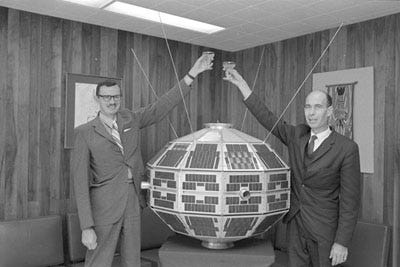
If Maritime Launch holds to its dictated DND schedule, rocket launches from Nova Scotia will mark a return to a long-ago Canadian capability and interest in being a space power. We may not really know our Canadian historical space lore, but the milestones include being the third country to build and operate a satellite in space (after the Soviet Union and the US), with the launch of the Alouette 1 research satellite in September 1962, which orbited for 10 years (nine longer than expected) collecting data on the ionosphere. [9]
(Raise a toast to Alouette 1)
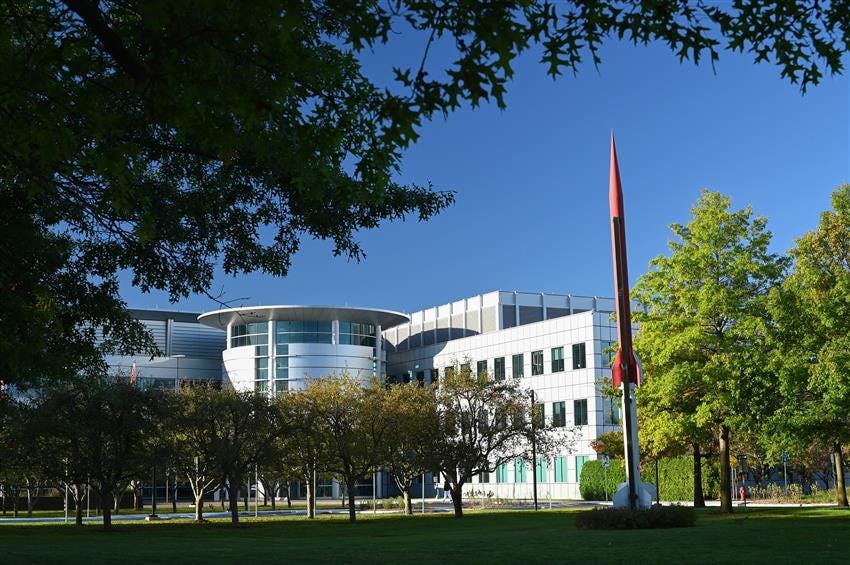
Starting in the late 1950s, Canada and the US collaborated to build a rocket launch site at Churchill, Manitoba, which was used to put rockets up into the higher reaches of the atmosphere for research. The Churchill launch site operated for some 30 years, until it was decommissioned in 1988. In that time, it sent up some 3500 rockets, many of Canadian design—the Black Brant missile. Nothing is left of the Churchill research range, and the only remaining Black Brant missile is mounted on a pedestal in front of the Canadian Space Agency.
Keeping in mind Mark Carney’s warning against nostalgia, all that one might say, pace Margaret Atwood, is that sending rockets and stuff into space has some Canadian ‘good bones.’ Let’s hope distant genes boost the chances of the Nova Scotia spaceport, and that of a rival being built on the Newfoundland coast by another start-up, NordSpace, not yet the beneficiary of DND dollars. [10] But certainly equally ambitious.
The Nordspace launch site!

Repeat after me, Space Launch Renaissance!
[1] Department of National Defence, “Minister McGuinty announces strategic investments in sovereign space launch,” March 16, 2026, https://www.canada.ca/en/department-national-defence/news/2026/03/minister-mcguinty-announces-strategic-investments-in-sovereign-space-launch.html; the press conference can be viewed here: https://www.cpac.ca/headline-politics/episode/federal-government-announces-funding-for-spaceport?id=21ad7282-9a48-4507-86a5-1708bc7080f4
[2] Department of National Defence, “Defence Industrial Strategy,” February 26, 2026, https://www.canada.ca/en/department-national-defence/corporate/reports-publications/industrial-strategy/security-sovereignty-prosperity.html
[3] Ibid
[4] Miles O’Brien, “From New Zealand to Orbit: How Rocket Lab is building a scrappier space economy,”

[5] Maritime Launch Services, https://www.maritimelaunch.com/why-nova-scotia
[6] Department of National Defence, “Minister McGuinty announces strategic investments in sovereign space launch,” March 16, 2026, https://www.canada.ca/en/department-national-defence/news/2026/03/minister-mcguinty-announces-strategic-investments-in-sovereign-space-launch.html
[7] Space Q, “Launch the North: Canada bets $305 million on domestic rockets and a Nova Scotia Spaceiort to secure the high ground,” March 16, 2026, https://spaceq.ca/launch-the-north-canada-bets-305m-on-domestic-rockets-and-a-nova-scotia-spaceport-to-secure-the-high-ground/; https://www.cbc.ca/news/politics/space-launch-pad-nova-scotia-9.7130406
[8] NATO, “NATO’s approach to Space,” July 30, 2025, https://www.nato.int/en/what-we-do/deterrence-and-defence/natos-approach-to-space
[9] Canadian Space Agency, “Canadian Space Milestones,” https://www.asc-csa.gc.ca/eng/about/milestones.asp
[10] Nordspace, https://www.nordspace.com/info
The Canso spaceport has been kicking around for years. Until this announcement, it looked like a boondoggle. Check out the coverage of the Halifax Examiner.
And we'll all just ignore the Kessler effect.